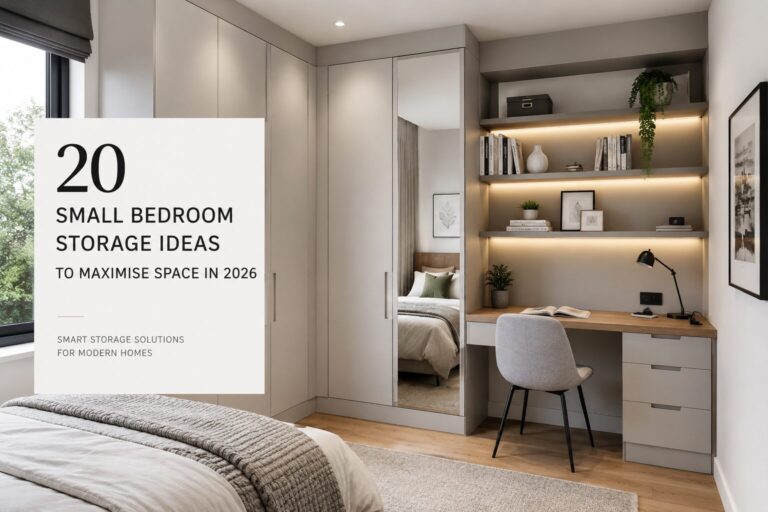
When you’re planning a fitted wardrobe, the door type is one of the first big decisions you’ll make, and it’s a bigger one than it might first seem. Sliding wardrobes have become one of the most requested styles for London bedrooms, largely because they solve a problem that hinged doors simply can’t: space. Here’s what actually sets sliding wardrobes apart, and how to know if they’re the right fit for your room.
Why Sliding Wardrobes Work So Well in London Homes
The biggest advantage of a sliding wardrobe is straightforward: the doors don’t swing outward. A hinged wardrobe door needs clearance to open fully, which in a smaller bedroom often means losing floor space you didn’t realise you needed until a bed or chest of drawers is in the way. Sliding doors run along a track and glide sideways instead, so there’s no arc of clearance to plan around.
This makes them particularly well suited to typical London bedroom layouts, where space is tight and every wardrobe is competing with a bed frame, a radiator, or a window for room to breathe.
Style Options Beyond the Basics
Sliding wardrobes aren’t a single look. The panels themselves can be finished in mirror, glass, wood veneer, or matte lacquer, and each brings something different to the room.
Mirrored sliding doors do double duty as a full-length mirror while also visually bouncing light around the room, which makes them a popular choice for bedrooms that don’t get much natural light. Glass panels, whether frosted or clear with backlighting, tend to suit a more contemporary space. Wood veneer or matte finishes work well where you want the wardrobe to blend into the room’s existing colour scheme rather than stand out.
Because the doors run on a track rather than swinging open, sliding wardrobes also lend themselves well to floor-to-ceiling designs, letting the wardrobe use the full height of the room without a door catching on the ceiling or coving.
Sliding vs Hinged: The Real Trade-Offs
Sliding doors aren’t automatically the better choice for every room, and it’s worth being honest about the trade-offs.
On the plus side, sliding wardrobes save floor space, offer a cleaner, more streamlined look, and suit larger openings well, since a single sliding panel can cover more width than a hinged door comfortably can. They’re also quieter to close and don’t risk swinging into furniture or a doorway.
The trade-off is that you can typically only access one section of the wardrobe at a time, since one door has to be slid across to reveal the space behind it. Hinged doors, by contrast, let you open the whole wardrobe at once, which some people find more convenient for a full view of everything inside. Sliding wardrobes also rely on a track system, so it’s worth having that fitted properly to keep the doors running smoothly for years rather than sticking or rattling.
What to Check Before You Commit
A few practical points are worth raising with your designer before the design is finalised:
Track quality. A well-fitted track should run smoothly with minimal noise. Cheaper systems can develop a rattle or stick over time, so it’s worth asking what hardware is being used.
Door weight and size. Larger mirrored or glass doors are heavier, and the track and rollers need to be rated to handle that weight without sagging over time.
Interior access. Since only part of the wardrobe is visible at once, think about how the interior is laid out. Placing everyday items behind the section you use most, and less frequent items behind the other, makes a real difference day to day.
Ceiling and floor levels. In older London properties, floors and ceilings aren’t always perfectly level, and a sliding track needs an accurate, true measurement to run smoothly. This is one of the reasons a proper site visit matters more for sliding wardrobes than for most other styles.
Getting the Design Right
Sliding wardrobes reward good planning more than most fitted furniture, since the track, door weight, and interior layout all need to work together from the start. A designer visit lets you see finish samples in person, talk through the layout that suits your room, and get an accurate measurement before anything is built.
If you’re considering sliding wardrobes for your bedroom, book a free designer visit and we’ll help you find the right fit for your space.